
When we say, “don’t judge a book by its cover,” we usually think of the cover design. Yet all too often, readers are also judging fiction by the width of the spine. But is bigger better? When it comes to writing powerful prose, less is often more. Flash fiction can accomplish in one thousand words what novels can’t in one thousand pages, but there’s more to it than simply cutting the word count. There is an art to brevity.
In this course, you will learn what makes a flash story tick. Through a combination of discussion, exercises, and prompts, the class will explore how to infuse stories with immediacy, focus the premise, fully explore a given theme, and bring the narrative to a satisfying resolution, all in 1000 words or less. No matter your preferred form, your prose will benefit from the skills you develop mastering flash.
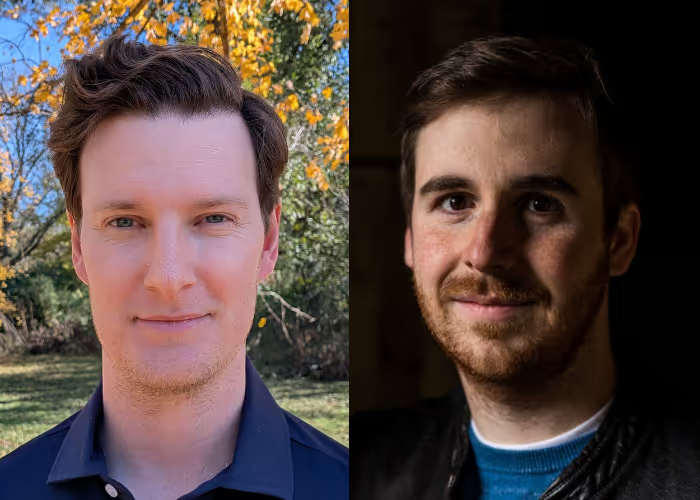
Thomas J. Griffin is a life-long fiction lover and sumo wrestling enthusiast who lives in Nashville, Tennessee and works out of an attic that could use more natural light. He is the co-founder of Flash Point SF, and his own short stories have appeared in publications such as Daily Science Fiction, 100-Foot Crow, Black Hare Press, and elsewhere.
M.A. Dosser is the co-founder and editor of Flash Point SF and a senior lecturer of communication studies at Vanderbilt University. He is the author of Nostalgic Futures: The Reactionary Fantasies of Speculative Fiction Fandoms (Rutgers University Press, 2026). You can read about his creative and scholarly work at maxdosser.com.
"Thomas and Max were great at offering guidance and advice on building a fantasy world for my book! I feel like I have enough ideas and guideposts to push forward on my own now."
"Max and Thomas were super down to earth and helpful. They clearly have a thorough knowledge of the subject and I have a lot of good takeaways from their class."
"Max and Thomas were organized with the material, thoughtful with their follow-up, and mindful about writing exercises. They put a lot of thought into the lessons, asked great questions, and created an open and comfortable environment. It also helped that they're both personable, kind, and genuinely want to see writers succeed and have fun with their craft."


