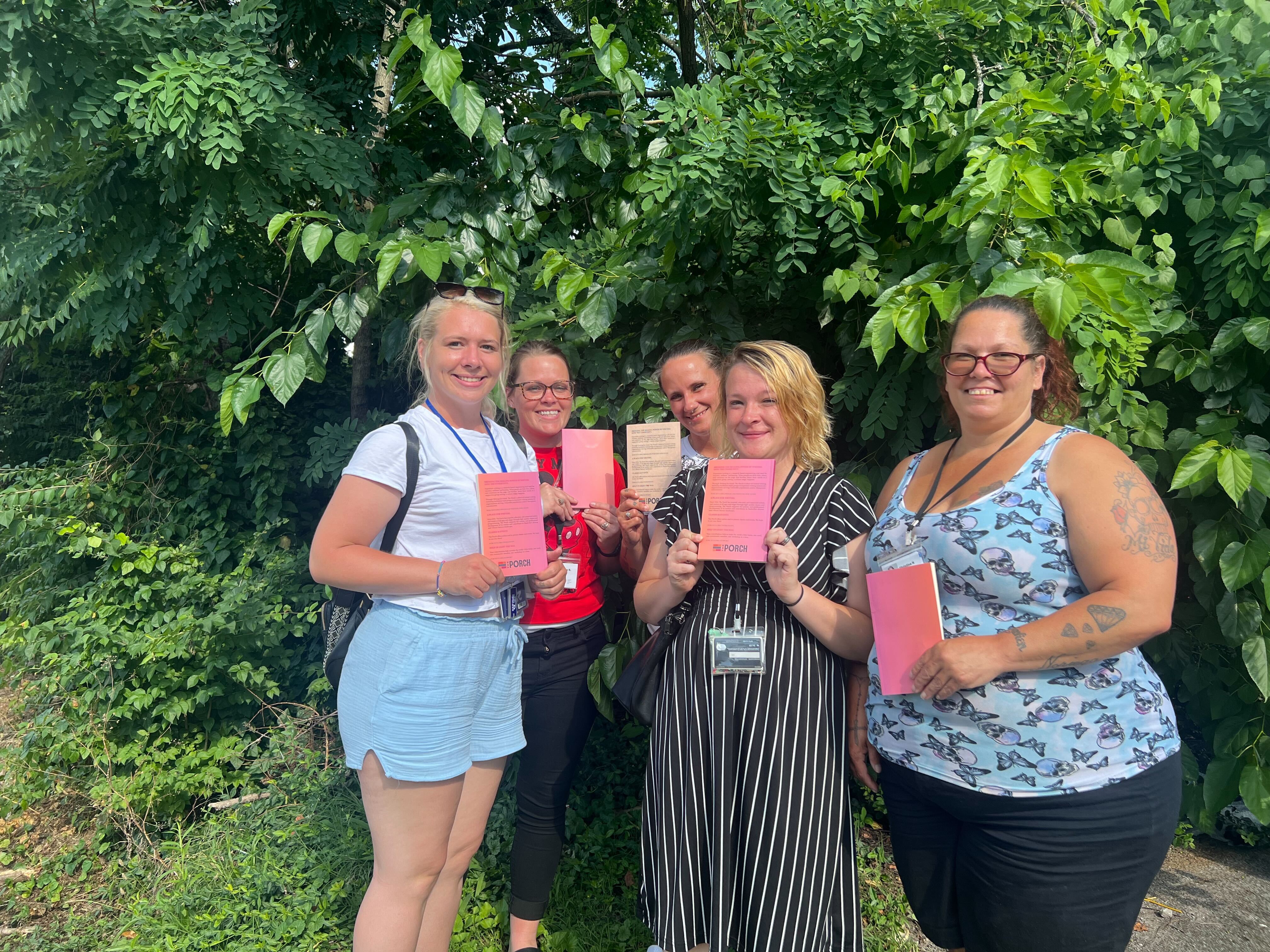
In late summer 2022, when Trina Frierson, founder and Executive Director of Mending Hearts, a residential addiction recovery center for women, invited me to teach a writing workshop, I entered the classroom with a satchel full of trepidation and nerves, certain it would be a one-and-done. The women there were in the trenches, many fresh out of incarceration and/or detox, and a well-meaning lady wielding pen, paper, and knowledge of the writing craft was not likely to land. Upon taking my seat, I promised this was not their high school English class. No red ink, no right or wrong way of doing this.
Here's what happened: Those women wrote their hearts out. They shared. They cried, laughed, and loved. If I walked in heavy with doubts, I walked out light, changed. In my nearly three decades as both a classroom teacher and Porch instructor, I'd taught thousands of lessons, many memorable and dear, but never had I experienced anything like what happened in that Thursday morning group at Mending Hearts.
For some, the ink recalls something they’d forgotten, a lost puzzle piece found—a grown man weeps at the memory of his grandmother’s kitchen table.
I didn’t know it then, but I was piloting what would become Writing for Good. A year later, The Porch hosted a facilitator training for interested Porch community members to introduce the fundamentals of research-supported expressive writing and trauma-informed care. Fast forward two years. The Porch has provided nearly 3000 participant engagements over 650 hours of programming. We currently run regular programs at Mending Hearts, Cumberland Heights, Men of Valor, Gilda’s Club, and Belmont Villages. In 2025, we launched our own Writing for Recovery every Sunday evening at The Porch House.
A certain alchemy happens in these rooms, a magical unfolding. A facilitator delivers a thoughtfully crafted writing prompt, often modeled by a poem or passage designed to encourage a personal excavation of life, thoughts, and emotion. The writing exercise is timed, creating an urgency that allows for unfiltered, unedited responses in which the unconscious surfaces. For some, the ink recalls something they’d forgotten, a lost puzzle piece found—a grown man weeps at the memory of his grandmother’s kitchen table. For some, the writing brings clarity, a fresh perspective—resentment toward a neglectful parent morphs into empathy, and perhaps forgiveness. For some, it’s turning an experience or emotion into unexpected art. “I had no idea I was a poet! It just came out.”
The timer sounds, and there’s the sharing. It’s optional but invariably someone says, “Oh, heck. I’ll go.” Vulnerability meets compassion, encouragement, the recognition of shared experience, communion. Another bold soul volunteers, and then another. When it’s time for a new prompt, the writers are primed, ready to plumb the depths again.
I’m never surprised when I receive a message from a facilitator, “This morning’s session was another doozie. Almost every one of them wept as they read their piece, and then they all laughed about how everyone was weeping at their revelations. It was powerful.” (direct quote from this past fall).
In 2024, we organized a focus group with women from Mending Hearts. One of them shared:
"I don't like writing at all. I didn't, but something about that class really opened my mind to new things, and I think it's one of the things that's going to help me stay clean because I still write. I wrote the other night. I think it's very helpful because, for me, it's easier to write it down than to say it aloud. It's like I get more in depth of how I really feel on paper.”
Of course, The Porch did not invent writing workshops in prisons, halfway houses, and homeless shelters. What makes Writing for Good unique, however, is our cohort of thirty-plus vetted, trained, paid facilitators. Our onboarding process involves education, shadowing and team-teaching, access to an ever-growing bank of lesson plans and resources, and bi-annual professional development. In FY26, The Porch will spend $16,000 in facilitator compensation—and that’s if we simply stick with our current load. (With Mending Heart’s new campus in East Nashville, the number of workshops and individuals served may double in the coming months.) The program wouldn’t be possible without the support of TN Arts Commission, Memorial Foundation, and the generous donations from individual donors. However, the opportunity to serve more organizations and individuals is exponential.
Through Writing for Good, The Porch is helping individuals seeking a fresh start write their way toward an examined life. They are acquiring the act of writing as a healthy habit and as an instrument of reframing their stories. Inside notebooks, these individuals are constructing nothing short of meaning and identity, creating intentionality around gratitude, forgiveness, hope, and wisdom. Those of us who have long been writing know its power—that writing can be a bridge to our better selves.